
At a Glance
- Organizational culture is shaped not by stated values, but by the behaviors leaders consistently tolerate or address in the workplace.
- Leadership tolerance of negative behaviors can gradually erode team cohesion, trust, and performance, eventually redefining organizational standards.
- Accountability culture—where clear boundaries and non-negotiable behaviors are established and enforced—serves as the foundation for psychological safety and healthy team dynamics.
- Tools like The Maxwell Leadership Team Culture Health Scorecard™ provide objective data to help leaders identify gaps between intended culture and lived experience, enabling targeted interventions.
- Effective cultural management requires leaders to act deliberately: addressing issues promptly, modeling positive behaviors, reinforcing expectations, and encouraging open dialogue for a thriving, innovative organization.
The saying “Culture is what you tolerate” highlights how leaders shape organizational culture by what they allow within their teams. Culture goes beyond formal values; it’s defined by daily actions that are accepted, ignored, or challenged. Leaders influence culture not just by what they reward, but also by what they tolerate. Allowing negative behaviors to go unchecked sends strong signals about acceptable conduct and affects accountability. Over time, this quietly undermines standards and reshapes culture.
This article explores how tolerated behaviors affect trust, accountability, teamwork, and organizational standards. Understanding these dynamics helps leaders manage culture intentionally, reinforcing positive behaviors aligned with strategic goals and addressing those that undermine success.
Understanding Organizational Culture Beyond Words
Organizational culture definition extends beyond formal documents such as mission statements, core values, or vision declarations. These stated values serve as a framework, but the real culture of an organization reveals itself through the everyday attitudes and behaviors that employees observe and practice. This distinction is critical because culture is not what is written on a wall; it is what happens in daily interactions and decisions.
The Role of Leadership Tolerance
Leadership tolerance plays a pivotal role in shaping these lived experiences. When leaders allow certain attitudes or behaviors to persist unchallenged, those actions become normalized and implicitly accepted as part of the organizational culture. This process transforms individual actions into collective norms that influence how teams operate and how people relate to one another.
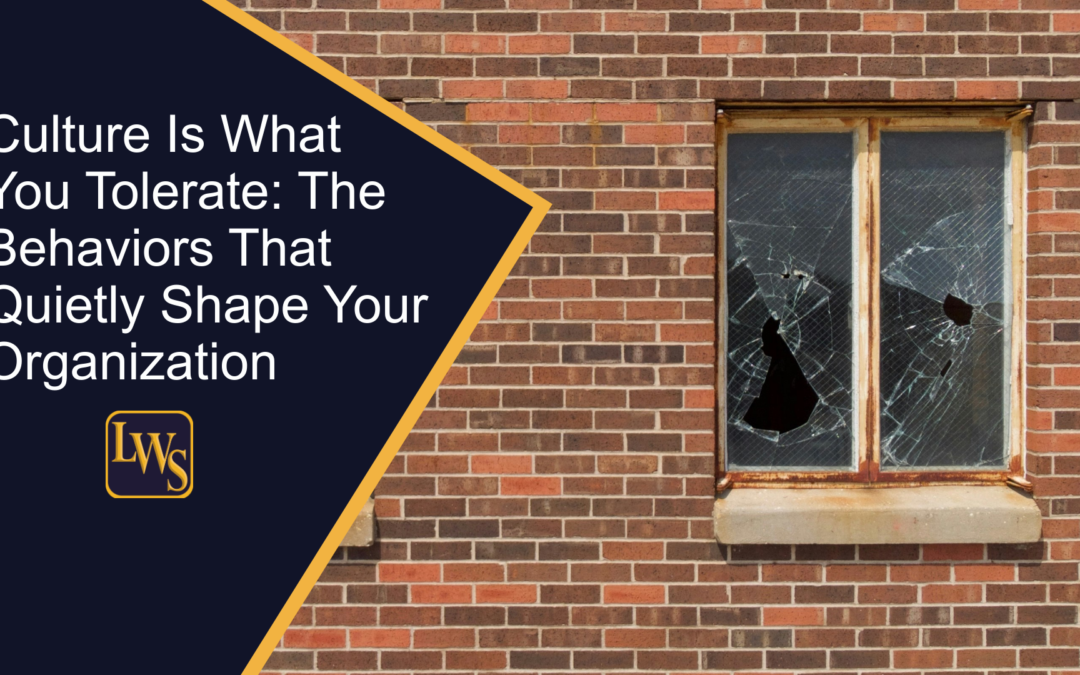
This dynamic is reminiscent of the “broken windows” theory, which suggests that visible signs of disorder or minor infractions—if left unaddressed—signal that inappropriate behavior is acceptable, leading to further erosion of standards. In workplace settings, when small negative behaviors are tolerated, they can quickly escalate and set a precedent for what is permissible, ultimately impacting team morale and overall performance.
Common Negative Behaviors in Workplaces
Common negative behaviors often tolerated across workplaces include:
- Disrespect, such as dismissive communication or undermining colleagues
- Mediocrity, where minimum effort is accepted instead of striving for excellence
- Gossip, which erodes trust and creates divisiveness
- Missed deadlines, signaling a lack of accountability and commitment
These behaviors silently communicate what the organization truly values. When overlooked, they undermine formal cultural aspirations by embedding low standards into everyday work life.
Culture as a Lived Experience
Culture functions as a lived experience, shaped continuously by what leadership chooses to accept or ignore. The gap between expressed values and actual practices can cause frustration among employees who value integrity and high performance but witness contradictory behaviors rewarded or tolerated.
Bridging the Gap
Recognizing this dynamic enables leaders to focus attention not just on articulating ideals but on actively managing the environment where real culture takes shape—through consistent expectations, clear consequences, and modeling desired conduct.
The Leadership Role in Shaping Culture Through Tolerance
Leadership accountability is the foundation of organizational culture. Every decision a leader makes—whether to address a behavior or to overlook it—speaks louder than any formal policy or mission statement. Actions and inactions alike send clear signals about what is acceptable, establishing the cultural tone setting that guides employee conduct and team dynamics.
The Power of Leader Influence on Culture
- Message through Action
When leaders respond swiftly to positive behaviors and confront inappropriate ones, they reinforce desired cultural standards. Silence or avoidance, however, often communicates tacit approval, allowing toxic or unproductive behaviors to take root.
- Consequences of Tolerating Negativity
Erosion of Trust: Employees lose confidence in leadership when harmful actions go unchecked.
Morale Decline: Tolerated negativity breeds resentment and disengagement.
Decreased Productivity: Dysfunctional behaviors disrupt workflow and collaboration.
Why Leaders Sometimes Tolerate Negative Behaviors
Leaders face real challenges that can lead them to tolerate problematic conduct:
- Fatigue: Constant demands can exhaust even the most dedicated leaders, prompting avoidance of difficult conversations.
- Fear of Confrontation: Addressing issues directly may feel risky or uncomfortable, especially when relationships are at stake.
- Habitual Inaction: Over time, ignoring small infractions becomes a pattern that unintentionally lowers standards.
Such silence has consequences. It undermines leadership credibility and allows damaging behaviors to escalate unchecked.
“Culture eats strategy for breakfast.” — Peter Drucker
This famous quote underscores the profound responsibility leaders carry in culture management. No strategic plan can succeed if the underlying culture is misaligned or neglected. Leadership accountability is not optional; it shapes the foundation upon which all organizational efforts rest.
Leaders must recognize their role as architects of culture by actively choosing what behaviors they tolerate. This conscious curation ensures that organizational values translate into lived realities rather than remaining abstract ideals.
How Tolerated Behaviors Redefine Organizational Standards Over Time
Organizational standards rarely change suddenly. Instead, they evolve gradually as tolerated behaviors quietly reshape what is considered acceptable in the workplace. This process highlights the principle that culture is what you tolerate, making every leader’s response to daily actions a critical factor in defining shared norms and expectations.
Small Acts of Tolerance Shape Behavioral Norms Development
A single missed deadline left unaddressed may seem insignificant, but when repeated, it signals to others that timeliness is negotiable. Similarly, avoiding difficult conversations about performance or conduct gradually lowers the bar for accountability. These incremental allowances build a foundation where laxity becomes embedded in the team’s DNA, contributing to an organizational standards evolution in which subtle behavioral shifts recalibrate what colleagues expect from one another. Without intentional course correction, these small acts accumulate, normalizing behaviors that once would have been unacceptable.
Examples from Workplace Expectations
Missed Deadlines
Initially treated as an exception, missed deadlines can over time become flexible targets rather than firm commitments. This flexibility erodes urgency and discipline across projects.
Avoidance of Difficult Conversations
When feedback on underperformance or interpersonal conflict is deferred or softened, problems remain unresolved, fostering resentment and disengagement. The absence of candor diminishes trust and transparency throughout the team.
Tolerance of Disrespectful Communication
When microaggressions or dismissive remarks go unchecked, team members grow accustomed to lowered standards of respect. Psychological safety deteriorates, stifling collaboration and innovation.
Each instance illustrates how workplace expectations are not only declared in policies but lived through everyday interactions. What leadership tolerates informs what employees internalize as the norm.
The Slippery Slope Effect on Team Cohesion and Performance
When standards slip, the consequences ripple throughout the organization:
- Team Cohesion Weakens: Members lose confidence in collective reliability when commitments are inconsistently honored. Trust fractures as unpredictability replaces dependability.
- Performance Declines: Lowered expectations lead to diminished effort and creativity. Productivity can stagnate as mediocrity becomes the new baseline.
- Frustration and Turnover Increase: High performers may disengage or exit when their values clash with prevailing norms shaped by tolerance of substandard behavior.
Leaders who recognize this slippery slope must confront tolerated behaviors promptly to preserve the high standards essential for sustainable success. The ongoing development of cultural norms hinges on consistent reinforcement aligned with core values rather than passive acceptance of declining practices.
Accountability Culture as a Foundation for Healthy Team Culture
An accountability culture is essential for maintaining positive behavior in the workplace and raising organizational standards. It creates an environment where individuals take responsibility for their actions, decisions, and commitments. This culture focuses on promoting accountability for continuous improvement and collective success rather than placing blame.
Defining Accountability Culture
Accountability culture refers to a work environment where:
- Clear expectations are set, understood, and consistently enforced.
- Team members are encouraged to meet commitments, openly discuss mistakes, and support each other’s growth.
- Leaders hold everyone accountable—from executives to frontline employees—for their roles and impact on the team.
Preventing the Normalization of Negative Behaviors
When accountability is weak or inconsistent, negative behaviors can become accepted norms over time. Examples of such behaviors include:
- Ignoring missed deadlines without consequences
- Avoiding difficult conversations about performance or conduct
- Allowing recurring errors to go unaddressed
By consistently enforcing standards, leaders send a message that these behaviors are not acceptable. When leaders actively reinforce expectations, they create an environment where excellence is the norm rather than the exception.
Accountability’s Role in Psychological Safety
Psychological safety flourishes when individuals trust that responsibility will be managed fairly without fear of punishment or ridicule. This sense of security empowers teams to:
- Engage in honest and constructive conflict resolution
- Share innovative ideas without hesitation
- Learn from failures in a positive manner
Contrary to popular belief, accountability does not stifle creativity; instead, it establishes a respectful framework that encourages risk-taking and collaboration.
“Leadership is less about control and more about cultivating a mindset where accountability is embraced as a pathway to growth.”
By embedding strong accountability practices, organizations can cultivate high-performing teams built on trust, clarity, and mutual respect. These fundamental elements serve as the bedrock upon which all other aspects of a healthy organizational culture rely.
Practical Strategies for Leaders to Manage What They Tolerate
Successful leadership requires intentional action in managing workplace behavior. The subtle signals leaders send about what is acceptable shape cultural norms and organizational standards. Effective leadership strategies for cultural change involve clear communication, consistent enforcement, and active engagement with the team.
Define Non-Negotiable Behaviors Aligned with Core Values
Explicitly identify behaviors that align with the organization’s mission and values.
- Develop a concise set of non-negotiables that serve as the foundation for expectations.
- Communicate these clearly to all employees through multiple channels—onboarding, team meetings, written policies.
Example: If respect is a core value, behaviors such as interrupting colleagues or dismissing ideas should be clearly categorized as unacceptable.
Address Problematic Behaviors Promptly
Intervene early when issues arise to prevent implicit acceptance.
- Use private, direct conversations to address concerns before patterns develop.
- Document incidents to maintain accountability and transparency.
Ignoring toxic or unproductive behavior sends a silent message that it is tolerated. Addressing problems swiftly preserves team morale and prevents erosion of standards.
Model Desired Behaviors Consistently
Leaders must embody the behaviors they expect from their teams.
- Demonstrate accountability by owning mistakes openly.
- Show respect in communications and decision-making processes.
Employees mirror leadership actions more than words. Consistent role-modeling sets the tone and reinforces cultural expectations authentically.
Reinforce Positive Behaviors Through Recognition
Celebrate adherence to standards publicly and privately.
- Use recognition programs that highlight examples of collaboration, integrity, and innovation.
- Communicate stories of success beyond formal policy documents to embed values into daily experience.
Acknowledging positive contributions motivates others to follow suit, strengthening the culture one interaction at a time.
Encourage Open Dialogue to Surface Issues Early
Create safe spaces for employees to express concerns without fear of retaliation.
- Use regular check-ins, anonymous feedback tools, and team forums to identify emerging challenges.
- Facilitate conversations around difficult topics before they become entrenched problems.
Proactive communication prevents small issues from escalating and enables continuous cultural refinement.
“Managing workplace behavior requires vigilance and courage. Leadership strategies that prioritize clarity, consistency, and open communication transform tolerance into tangible cultural change.”
Enforcing standards involves more than rules; it demands an ongoing commitment to shaping everyday interactions aligned with organizational values. This approach ensures behaviors that support success thrive while those that undermine it are addressed decisively.
Using Data to Gain Visibility into Actual Culture
Organizational culture is often discussed in abstract terms. Leaders talk about values and mission statements, but the reality within teams can be very different from what they hope for. This gap exists because culture is not just what is said—it is what is accepted. To understand this, we need more than just gut feelings or stories; we need careful measurement based on evidence.
The Necessity of Evidence-Based Culture Diagnostic Tools
Culture diagnostic tools are essential for moving beyond assumptions about how healthy an organization is. If we only rely on what people think or what leaders want, we might miss deep-rooted behaviors that quietly harm teamwork and performance. Measurement based on data gives us a clear picture of how people really think, act, and interact every day.
Key benefits of data-driven culture improvement include:
- Objectivity: Captures real-time insights free from bias or wishful thinking.
- Transparency: Provides a shared reference point for leadership and teams.
- Actionability: Identifies specific behavior patterns and attitudes that require intervention.
- Accountability: Tracks progress over time towards cultural goals aligned with organizational values.
Without these tools, leaders might overlook subtle signs of acceptance for negative behaviors that damage trust and accountability, weakening the foundation needed for high-performing teams.
The Maxwell Leadership Team Culture Health Scorecard™
The Maxwell Leadership Team Culture Health Scorecard™ is a comprehensive tool designed specifically to diagnose the gap between stated cultural intentions and actual employee experiences. It combines qualitative and quantitative inputs to reveal discrepancies between the intended culture leaders want to create and the actual culture employees experience.
Components of the Scorecard include:
- Behavioral Assessments: Measures frequency and impact of key behaviors aligned with core values.
- Trust Metrics: Gauges levels of psychological safety and openness across teams.
- Accountability Indexes: Evaluates consistency in following through on commitments like deadlines and respectful communication.
- Engagement Indicators: Assesses employee commitment to shared goals and willingness to challenge counterproductive norms.
This approach uncovers not only individual problems but also broader trends that shape collective experiences every day.
Leveraging Actionable Data for Targeted Culture Enhancement
Data from The Maxwell Leadership Team Culture Health Scorecard™ empowers leaders to identify specific areas where their attention will have the biggest impact. Instead of making broad or reactive changes, leaders gain strategic insights into:
- Which tolerated behaviors are most damaging relative to team dynamics.
- Areas where accountability mechanisms are weak or inconsistently applied.
- Patterns indicating erosion of standards that threaten productivity or morale.
- Positive cultural pockets that can serve as models or incubators for wider adoption.
By focusing on these insights, organizations avoid the mistakes of ignoring warning signs until they become crises. Instead, they use real-time feedback loops to reinforce desired behaviors while quickly addressing emerging challenges.
Leaders who use these data-driven tools show their commitment not just to cultural aspirations but also to measurable progress. This clarity turns vague ideas about “culture” into concrete goals for development—based firmly on what individuals actually accept within their teams.
Benefits of Proactively Managing Culture Through Accountability
Accountability is crucial for creating a successful organizational culture. Its advantages extend to every part of the workplace, directly affecting team interactions, individual actions, and the overall well-being of the organization.
Improved Trust Within Teams
Trust grows when negative behaviors are not ignored or accepted. When leaders deal with problems fairly and openly, employees feel confident in the honesty of their surroundings. This trust establishes a solid base for collaboration and constructive conflict resolution instead of letting issues linger in silence.
Enhanced Productivity Through Clarity and Consistency
Clear expectations combined with consistent follow-through on commitments—such as meeting deadlines and maintaining respectful communication—boost productivity. Employees know what is expected of them and see that standards apply to everyone, eliminating confusion and encouraging focused efforts towards common objectives.
Reduced Turnover Fueled by Psychological Safety
Employees are more likely to stay when they feel valued in a workplace that upholds integrity and psychological safety. Accountability practices ensure that contributions are acknowledged and harmful behaviors addressed promptly. This atmosphere fosters job satisfaction, loyalty, and long-term involvement.
Cultivation of Innovative Thinking Within Accountable Frameworks
A culture that embraces diversity within accountable boundaries encourages innovative thinking. By holding all team members responsible for respectful discussions and openness to new ideas, organizations unlock creativity. Diverse viewpoints can thrive safely without fear of blame or marginalization, promoting adaptability in shifting markets.
Understanding these benefits emphasizes why accountability should be actively managed instead of passively wished for. It changes tolerance from silent acceptance into deliberate nurturing of excellence in trust-building, productivity, retention, and innovation.
“Accountability is not about blame; it is about ownership—ownership that empowers teams to deliver their best.”
Conclusion
Effective leadership in shaping organizational culture requires deliberate management of what is tolerated in the workplace. Culture is defined by what leaders allow, making their choices crucial to either strengthening or weakening the organization’s foundation. Intentional oversight preserves cultural standards, as leaders set clear boundaries by addressing behaviors that threaten team cohesion, trust, and performance. Inaction signals acceptance.
Decisions to tolerate or confront certain behaviors have lasting effects. Leaders ultimately decide what becomes normalized. Every choice about permitted behavior shapes the culture, making it essential to carefully determine which actions are allowed to persist for a thriving, accountable, and innovative environment.
Tools like The Maxwell Leadership Team Culture Health Scorecard™ help leaders objectively assess culture health, revealing gaps between stated values and actual experiences so interventions can be precisely targeted. Book a workplace culture assessment today to gain clear, actionable insights that strengthen alignment, trust, and engagement. : https://lornawestonsmyth.com/contact/
Are you clearly defining and communicating non-negotiable behaviors that uphold core values?
How promptly and effectively do you intervene when problematic behaviors arise within your team?
How are you using objective data or diagnostic tools to assess the true state of your organizational culture?
Contact me today for a complementary Strategy Session: Leadership Strategy Session
Or book me to speak at your next Event, Team Meeting, or Off-Site Retreat: Speaker Request